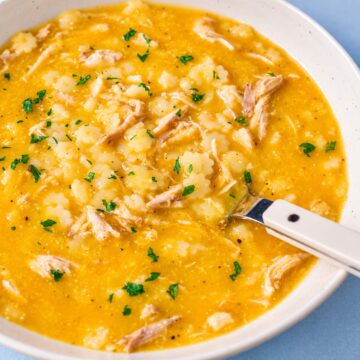
Pastina Soup (Italian Penicillin Soup)
Pastina soup with shredded rotisserie chicken, tiny pasta, and a blended carrot, celery, onion, and garlic broth, finished with lemon and Parmesan.
Ingredients
- 2 tablespoons extra virgin olive oil
- 1 medium yellow onion 150 g prepared weight, roughly chopped
- 2 medium carrots 200 g prepared weight, peeled and cut into 1 cm pieces
- 2 celery stalks 150 g prepared weight, cut into 1 cm pieces
- 3 garlic cloves peeled and lightly crushed
- 1.5 l low-sodium chicken broth
- 1 bay leaf
- ½ teaspoon fine salt plus more to taste
- ¼ teaspoon black pepper
- 150 g dry small wheat pasta preferably stelline
- 250 g rotisserie chicken skin and bones removed, meat shredded
- 30 g Parmesan finely grated, for serving
- 1 tablespoon fresh lemon juice add gradually to taste
Instructions
- Place 1 medium yellow onion, 2 medium carrots, 2 celery stalks, 3 garlic cloves, 1.5 l low-sodium chicken broth, 2 tablespoons extra virgin olive oil, 1 bay leaf, ½ teaspoon fine salt, and ¼ teaspoon black pepper in a 3–4 litre saucepan. Bring to a boil, reduce the heat, cover, and simmer gently for approximately 20–25 minutes, until the carrots crush easily with a fork.
- Remove and discard the bay leaf. Take the pan off the heat and blend until smooth with an immersion blender, keeping the blade submerged to prevent splashing.
- Return to a gentle simmer. Stir in the 150 g dry small wheat pasta and cook uncovered, stirring frequently. Use the package cooking time as a starting point, adding the chicken as described in the next step before the pasta finishes cooking.
- Add the 250 g rotisserie chicken, shredded, during the last 3–5 minutes of cooking the pasta. Continue simmering until the pasta is tender and the chicken is piping hot throughout.
- Remove from the heat. Stir in 1 tablespoon fresh lemon juice and 30 g Parmesan. Taste before adjusting the salt. Divide between four bowls and serve.
Notes
Blend before adding pasta: Blend the vegetables until completely smooth before stirring in the pastina, so the broth is silky and the pasta stays intact.
Pasta timing: Use the package timing as a starting point and taste the pasta to check doneness.
Seasoning: Rotisserie chicken and Parmesan contribute salt. Taste with both before adding more salt.
Add Parmesan off the heat: Finely grate the Parmesan and stir it in gradually after removing the saucepan from the heat to help it melt evenly without clumping.
Nutrition
Calories: 434kcal | Carbohydrates: 39g | Protein: 33g | Fat: 17g | Saturated Fat: 4g | Polyunsaturated Fat: 2g | Monounsaturated Fat: 7g | Cholesterol: 65mg | Sodium: 767mg | Potassium: 570mg | Fiber: 3g | Sugar: 4g | Vitamin A: 5166IU | Vitamin C: 6mg | Calcium: 134mg | Iron: 2mg
