Pierogi Dough Recipe
Soft, elastic pierogi dough made with four simple ingredients. The egg provides structure, while resting makes the dough easier to roll into thin circles.
Ingredients
- 250 g all-purpose flour plus more as needed for dusting
- ½ teaspoon salt
- 1 large egg room temperature
- 120 ml warm water warm to the touch
Instructions
- Combine 250 g all-purpose flour and ½ teaspoon salt in a large bowl. Make a well in the center, add 1 large egg, and begin incorporating it into the flour with a fork.
- Slowly pour in 120 ml warm water while continuing to mix. Once the pierogi dough comes together, knead it in the bowl for 5–7 minutes until smooth and elastic. If it feels sticky, add only a light dusting of additional flour.
- Cover the bowl tightly with plastic wrap and let the dough rest at room temperature for 30 minutes.
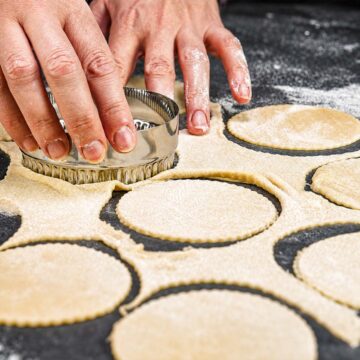
- Transfer the rested dough to a lightly floured surface and roll it to a thickness of 2–3 mm. Cut approximately 20 dough circles with a round cutter or the rim of a glass. Keep the circles and any remaining dough covered until ready to fill.
Notes
Check the Water by Touch: I use water that feels comfortably warm rather than hot because it helps the dough come together and makes kneading easier.
Limit the Extra Flour: Add only a light dusting when the dough feels sticky. Too much additional flour can make the finished dough harder to roll.
Allow the Full Resting Time: For me, the 30-minute rest is important because it relaxes the dough and prevents it from repeatedly springing back while rolling.
Keep the Dough Covered: Once exposed to the air, the surface and cut edges can dry out and become harder to seal around a filling.
Nutrition
Calories: 49kcal | Carbohydrates: 10g | Protein: 2g | Fat: 0.3g | Saturated Fat: 0.1g | Polyunsaturated Fat: 0.1g | Monounsaturated Fat: 0.1g | Trans Fat: 0.001g | Cholesterol: 8mg | Sodium: 62mg | Potassium: 16mg | Fiber: 0.3g | Sugar: 0.04g | Vitamin A: 12IU | Calcium: 3mg | Iron: 1mg
