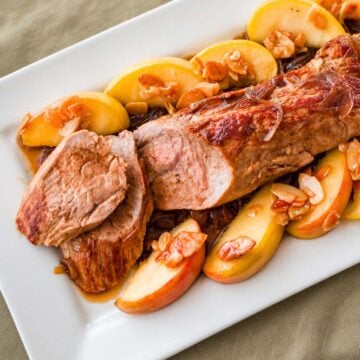
Pork Tenderloin with Apples
This pork tenderloin with apples pairs seared pork with a Pedro Ximénez onion sauce and separately caramelized apples and raw sliced almonds. It cooks entirely on the stovetop in 30 minutes.
Ingredients
- 400 g pork tenderloin 1 pork tenderloin, silver skin removed
- 2 tablespoons extra virgin olive oil divided
- ¼ teaspoon salt for the pork
- ⅛ teaspoon freshly ground black pepper for the pork
- 2 medium yellow onions sliced
- ½ teaspoon salt for the onions
- ¼ teaspoon freshly ground black pepper for the onions
- 100 ml Pedro Ximenez wine
- 100 ml water
- 1 apple cored and sliced, skin left on
- 2 tablespoons granulated sugar
- 50 g raw sliced almonds
- 1 tablespoon butter
Instructions
- Heat 1 tablespoons extra virgin olive oil in a large skillet over medium-high heat. Season 400 g pork tenderloin with ¼ teaspoon salt and ⅛ teaspoon freshly ground black pepper. Sear on all sides for 8–10 minutes, until evenly browned. Transfer to a plate.
- Add the remaining 1 tablespoons extra virgin olive oil to the same skillet. Add 2 medium yellow onions, sliced, ½ teaspoon salt, and ¼ teaspoon freshly ground black pepper. Cook over medium heat for 5–6 minutes, stirring occasionally, until softened.
- Pour in 100 ml Pedro Ximenez wine and scrape up the browned bits. Simmer for 2 minutes, then add 100 ml water and bring to a gentle simmer.
- Return the pork to the skillet. Simmer uncovered for 8–10 minutes, until the thickest part reaches 63 °C.
- While the pork simmers, place 1 apple, 2 tablespoons granulated sugar, 50 g raw sliced almonds, and 1 tablespoon butter in a separate pan. Cook over medium heat for 4–5 minutes, stirring often, until the apple begins to soften and the mixture caramelizes.
- Transfer the pork to a cutting board and rest for 5 minutes. Slice against the grain and serve with the Pedro Ximénez onions, caramelized apples, and almonds.
Notes
Check the temperature early: Pork tenderloin is lean, so begin checking before the estimated simmering time ends to prevent overcooking.
Control the wine reduction: Keep the Pedro Ximénez at a gentle simmer so its concentrated sweetness does not reduce too quickly.
Watch the sugar closely: Stir the apple and almond mixture often because the sugar can darken rapidly.
Coordinate both pans: Start the apple mixture while the pork simmers so both components reach the table warm.
Nutrition
Calories: 739kcal | Carbohydrates: 42g | Protein: 48g | Fat: 40g | Saturated Fat: 9g | Polyunsaturated Fat: 6g | Monounsaturated Fat: 22g | Trans Fat: 0.3g | Cholesterol: 145mg | Sodium: 1032mg | Potassium: 1270mg | Fiber: 7g | Sugar: 28g | Vitamin A: 233IU | Vitamin C: 12mg | Calcium: 120mg | Iron: 3mg
